Download the Lessonotes Mobile Liberia app for faster lesson access on Android and iPhone.


Subject: Physics
Semester: 1
Period: 3
Week: 14
School Name:
Teacher’s Name:
Subject: Physics
Grade Level: Grade 12
Week & Period: Week 14, Period III
Date:
Topic: Magnetic Fields
Sub-Topic: Types, Magnetic Flux, Magnetic Flux Density, and Force in a Magnetic Field
Learning Objectives:
By the end of the lesson, learners should be able to:
- Define magnetic fields and explain how they are represented.
- Differentiate between uniform and non-uniform magnetic fields.
- Define magnetic flux and flux density and relate them mathematically.
- Analyze the force experienced by a current-carrying conductor in a magnetic field.
- Apply Fleming’s left-hand rule.
Instructional Materials:
- Bar magnets
- Iron filings
- Cardboard sheet
- Compass
- Current-carrying conductor (wire)
- Power source
- Galvanometer
- Permanent magnets
- Magnetic field demonstrator
Anticipation (Warm-Up Activity):
Pose the question:
“Why does a compass needle always point in a particular direction?”
Demonstrate the deflection of a compass in the presence of a bar magnet.
Building Knowledge (Main Lesson):
- Magnetic Field:
- Defined as the region around a magnet where magnetic forces are experienced.
- Represented by lines of force or field lines.
- The direction of the field is from the North to the South pole.
- Types of Magnetic Fields:
- Uniform Field: Field lines are parallel and equally spaced (e.g., between two opposite poles of magnets).
- Non-Uniform Field: Field lines are curved and not equally spaced (e.g., around a single bar magnet).
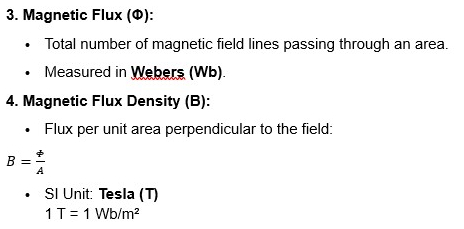
- Force in a Magnetic Field:
- When a current-carrying conductor is placed in a magnetic field, it experiences a force.
- The direction is given by Fleming’s Left-Hand Rule:
- Thumb = Force
- First Finger = Magnetic Field
- Second Finger = Current
- Magnitude of Force (F):
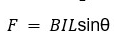
Where:
F = Force (N),
B = Magnetic Flux Density (T),
I = Current (A),
L = Length of conductor in the field (m),
θ = Angle between conductor and field
Activities/Experiment:
Experiment 1: Observing Magnetic Field Patterns
Materials: Bar magnet, iron filings, cardboard
Procedure:
- Place the magnet under the cardboard.
- Sprinkle iron filings evenly.
- Tap gently.
Observation: - Filings arrange along curved lines from N to S pole.
Conclusion: - Magnetic field lines emerge from the North pole and return to the South pole.
Experiment 2: Magnetic Field Due to Current
Materials: Straight wire, compass, power source
Procedure:
- Connect wire to battery
- Place compass around wire and observe deflection
Conclusion: - A current in a wire produces a circular magnetic field around the wire
Sample Calculation:
Question:
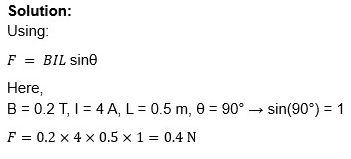
A straight conductor of length 0.5 m carrying a current of 4 A is placed perpendicular to a magnetic field of flux density 0.2 T. Calculate the force on the conductor.
Assessment (Class Work):
- Define magnetic flux and flux density.
- Differentiate between uniform and non-uniform magnetic fields.
- State and explain Fleming’s Left-Hand Rule.
- A wire of length 0.8 m carrying 5 A current lies in a magnetic field of 0.5 T. Calculate the force on the wire if it makes an angle of 30° with the field.
- Sketch the magnetic field around a bar magnet.
Homework:
- Research and write two real-life applications of magnetic force.
- Use Fleming’s left-hand rule to determine the direction of motion in electric motors.
Expanded Notes:
- Magnetic flux density is strongest where the field lines are closest.
- Electric motors use magnetic force to convert electrical energy into motion.
- Loudspeakers use the force on a coil in a magnetic field to vibrate a diaphragm.
Differentiation:
- Use 3D models for field line representation.
- Engage students with simulation apps for magnetic force and fields.
- Group learners to measure and draw magnetic field patterns.
Teacher’s Reflection:
- Were learners able to differentiate field types visually and conceptually?
- Did they apply the force formula and rule correctly in calculations and predictions?
- How well did hands-on experiments reinforce abstract concepts?