Download the Lessonotes Mobile Liberia app for faster lesson access on Android and iPhone.


Subject: Physics
Semester: 1
Period: 1
Week: 1
School Name:
Teacher’s Name:
Subject: Physics
Grade Level: Grade 12
Week & Period: Week 1, Period I
Date:
Topic: Refraction and Dispersion of Light
Sub-topic (Week 1): Refraction at Plane Interface – Laws of Refraction
Learning Objectives:
By the end of the lesson, learners should be able to:
- Define refraction.
- State and explain the laws of refraction.
- Identify everyday examples of refraction.
- Demonstrate refraction using simple apparatus.
- Draw and interpret ray diagrams showing refraction.
Previous Knowledge:
Learners have studied the straight-line propagation of light and can explain reflection.
Instructional Materials:
- Ray box/light source
- Plane glass block
- White paper or cardboard
- Rulers
- Protractors
- Pencils
- Water in a transparent container
- Drinking straw
- Calculator
Anticipatory Set (Warm-up):
Display a straw in a half-filled transparent cup of water and ask:
“Why does the straw appear bent or broken?”
Allow learners to speculate before introducing the concept of refraction.
Building Knowledge (Main Lesson):
Definition of Refraction:
Refraction is the bending or change in direction of light as it passes from one medium to another of different optical density (e.g., from air to water or glass).
Why Refraction Occurs:
Light changes speed when it enters a medium of different optical density.
- Slows down when entering a denser medium
- Speeds up when entering a rarer medium
Laws of Refraction:
- The incident ray, refracted ray, and the normal at the point of incidence all lie in the same plane.
- The ratio of the sine of the angle of incidence to the sine of the angle of refraction is constant for a given pair of media.
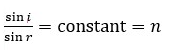
This is called Snell’s Law.
Real-Life Examples of Refraction:
- A pencil in water appears bent.
- A swimming pool looks shallower than it actually is.
- Mirage in hot deserts.
Demonstration (Teacher-led):
Title: Observation of Refraction Using a Glass Block
Apparatus:
- Rectangular glass block
- Ray box or torch
- White cardboard or paper
- Protractor and ruler
- Pencil
Procedure:
- Place the glass block on the white paper and trace its outline.
- Draw a normal line at one point on one face.
- Shine a ray of light from the ray box to hit the glass block at an angle to the normal.
- Mark the incident ray and the emergent ray.
- Remove the block and connect the points to trace the refracted ray inside the block.
- Measure the angle of incidence (i) and refraction (r).

Observation:
The ray bends toward the normal when entering glass and away from the normal when exiting.
Learners' Activities:
- In groups, repeat the glass block experiment.

- Plot a table of results.
Experiment – Bending of Light in Water
Title: Refraction of Light Through Water
Materials:
- Beaker
- Water
- Pencil or straw
- Ruler
Procedure:
- Place a pencil upright in the beaker of water.
- Observe from the side how the pencil appears bent.
- Draw a labeled diagram showing the light path from pencil to eye.
Explanation:
Light rays bend as they move from water (denser medium) to air (rarer medium), causing the object to appear bent or broken.
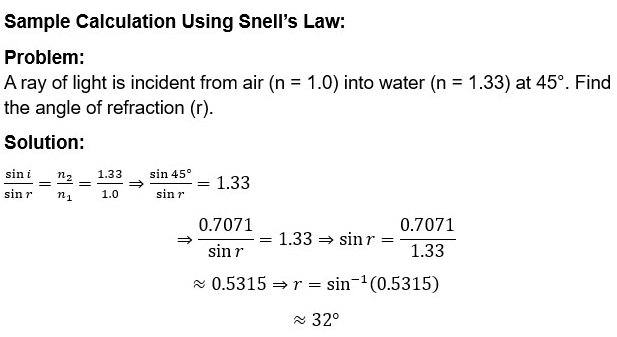
Sample Calculation Using Snell’s Law:
Problem:
A ray of light is incident from air (n = 1.0) into water (n = 1.33) at 45°. Find the angle of refraction (r).
Solution:
Assessment:
Classwork Questions:
- Define refraction and explain why it occurs.
- State and explain the two laws of refraction.
- What is meant by refractive index?
- A ray of light is incident at 30° to the normal in air and enters a glass block (n = 1.5). Find the angle of refraction.
- List two real-life applications of refraction.
Homework:
- Draw a labeled diagram showing refraction through a rectangular glass block.
- Find the refractive index of a material if angle of incidence is 45° and angle of refraction is 28°.
Expanded Notes and Key Ideas:
- Refraction causes objects under water to appear displaced.
- It is responsible for the operation of lenses in eyeglasses and cameras.
- Snell’s law is a fundamental principle in optical physics.
Differentiation (Support & Challenge):
- Provide visual aids for slower learners.
- Allow advanced learners to derive Snell’s law from experimental values.
- Use group practical work for kinesthetic learners.
Teacher's Reflection:
- Were learners able to differentiate between reflection and refraction?
- Did practical work help reinforce the laws of refraction?
- Were learners able to apply Snell’s Law accurately?