Download the Lessonotes Mobile Liberia app for faster lesson access on Android and iPhone.


Subject: Physics
Semester: 1
Period: 1
Week: 2
School Name:
Teacher’s Name:
Subject: Physics
Grade Level: Grade 12
Week & Period: Week 2, Period I
Date:
Topic: Refraction and Dispersion of Light
Sub-topic (Week 2): Refractive Index – Snell’s Law and Speed of Light
Learning Objectives:
By the end of the lesson, learners should be able to:
- Define refractive index.
- State and apply Snell’s Law in solving problems.
- Relate refractive index to the speed of light in different media.
- Perform calculations involving refractive index.
- Demonstrate understanding through class experiments.
Previous Knowledge:
Students are familiar with the laws of refraction and basic ray diagrams from Week 1.
Instructional Materials:
- Glass and perspex blocks
- Light box or torch
- White cardboard
- Protractors and rulers
- Scientific calculators
- Water tank or beaker
- Stopwatch
- Data chart for speed of light in different materials
Anticipation (Warm-up):
Pose this question:
“Why does light travel faster in air than in water or glass?”
Link to students’ prior experience with refraction and introduce the concept of refractive index.
Types of Refractive Index:
- Absolute refractive index: Medium compared to vacuum.
- Relative refractive index: One medium compared to another.
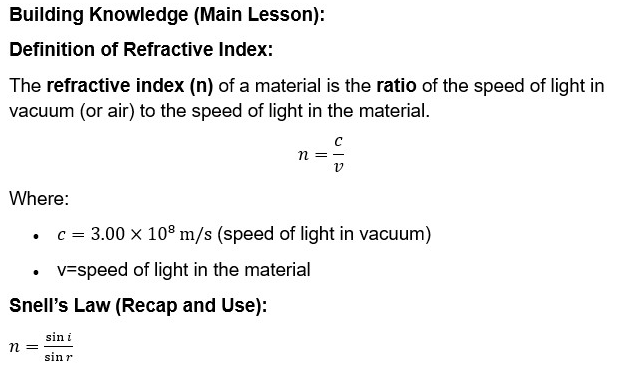
This formula is used to calculate the refractive index using angles of incidence and refraction.
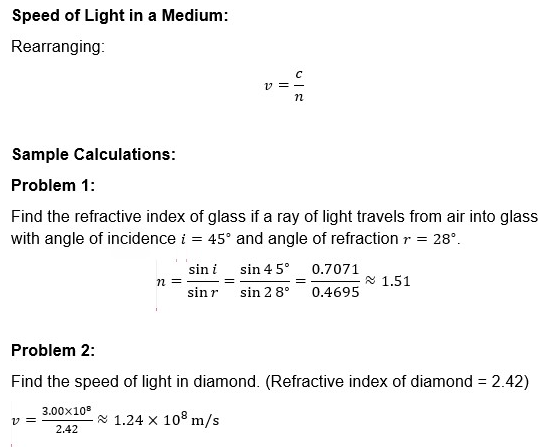
Experiment: Measuring Refractive Index of Glass Using Snell’s Law
Apparatus:
- Ray box or torch
- Protractor
- Glass block
- Ruler
- White paper
- Pencil
Procedure:
- Trace the outline of a rectangular glass block.
- Draw a normal and an incident ray at a known angle (30°, 45°, etc.).
- Shine the light and trace the refracted and emergent rays.
- Measure the angle of refraction.
- Use Snell’s Law to calculate the refractive index.
Learners’ Activities:
- Work in groups to carry out the experiment.
- Record angles and compute refractive index.
- Compare results with theoretical values for water, glass, and plastic.
Assessment:
Classwork Questions:
- Define refractive index.
- State Snell’s Law.
- A light ray passes from air into water. If the angle of incidence is 40° and the angle of refraction is 30°, find the refractive index.
- What is the speed of light in a medium with refractive index 1.6?
Homework:
- Research and list refractive indices of 5 materials.
- A material has a refractive index of 1.45. What is the speed of light through it?
Expanded Notes and Real-Life Applications:
- Lenses in glasses and microscopes rely on refractive index to function.
- Fiber optics use the concept of total internal reflection, which depends on refractive index.
- Diamonds sparkle due to their high refractive index.
Differentiation:
- Use colored ray diagrams for visual learners.
- Let advanced students derive the formula for refractive index from velocity relations.
- Group weaker learners with stronger ones during experiments.
Teacher's Reflection:
- Were students able to relate refraction to light speed changes?
- Did they interpret Snell’s Law correctly in calculations?
- Were experiments engaging and did they build deeper understanding?