Download the Lessonotes Mobile Liberia app for faster lesson access on Android and iPhone.


Subject: Physics
Semester: 1
Period: 1
Week: 3
School Name:
Teacher’s Name:
Subject: Physics
Grade Level: Grade 12
Week & Period: Week 3, Period I
Date:
Topic: Refraction and Dispersion of Light
Sub-topic (Week 3): Real and Apparent Depth, Critical Angle, and Total Internal Reflection
Learning Objectives:
By the end of the lesson, learners should be able to:
- Differentiate between real and apparent depth.
- Define and compute the critical angle.
- Explain and illustrate the concept of total internal reflection.
- Solve problems involving real depth, apparent depth, and critical angle.
- List applications of total internal reflection.
Previous Knowledge:
Learners are familiar with Snell’s Law, refractive index, and how light bends when it travels through different media.
Instructional Materials:
- Glass blocks
- Water tank/beaker
- Coin and transparent container
- Torch/ray box
- White paper and rulers
- Calculator
- Optical fiber demo (optional)
Anticipatory Set (Warm-up):
Drop a coin into a transparent container filled with water and ask learners:
“Why does the coin look closer than it really is?”
Introduce the idea of apparent depth and link it to refraction.
Building Knowledge (Main Lesson):
Real and Apparent Depth
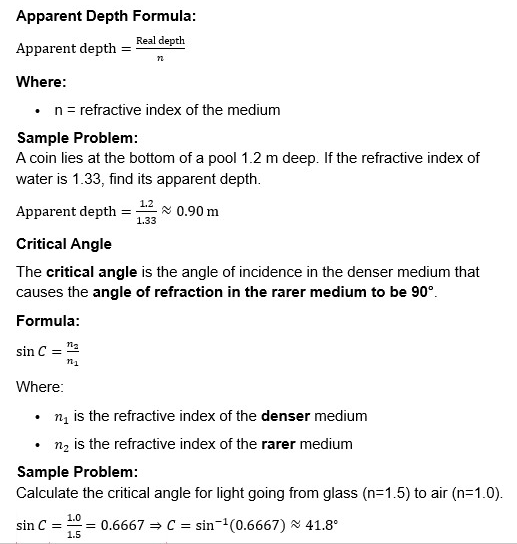
When light rays pass from a denser to a rarer medium, the object appears shallower due to the bending of rays.
Total Internal Reflection (TIR)
Occurs when:
- Light travels from denser to rarer medium, and
- Angle of incidence > critical angle
Applications of TIR:
- Optical fibers
- Periscopes
- Diamond brilliance
- Medical endoscopy
Experiment: Observing Total Internal Reflection
Apparatus:
- Glass block
- Ray box
- Protractor
- Paper and pencil
Procedure:
- Place the glass block on paper.
- Direct a light ray at increasing angles toward the interface.
- Measure angles where no light exits—observe internal reflection.
- Find the angle at which light no longer refracts but reflects completely.
Observation:
At the critical angle, the light grazes the surface. Beyond this, all light reflects back internally.
Learners’ Activities:
- Perform calculations using apparent depth and critical angle formulas.
- Use the glass block to observe TIR.
- Draw ray diagrams showing real and apparent depth.
- Discuss where and how TIR is used in daily life.
Assessment
Classwork:
- Define apparent depth.
- A tank is 1.5 m deep. What is the apparent depth if the refractive index is 1.25?
- What is the critical angle for a glass-air boundary (n=1.5n = 1.5n=1.5)?
- Explain two uses of total internal reflection.
Homework:
- Draw a diagram showing total internal reflection inside an optical fiber.
- Explain why diamonds sparkle using TIR.
- A diver underwater sees the sun directly overhead. Explain why they cannot see beyond a certain angle.
Expanded Notes and Applications:
- In a swimming pool, the bottom appears closer due to apparent depth.
- Optical fibers use total internal reflection to guide light over long distances.
- The sparkle of diamonds is due to their high refractive index and multiple internal reflections.
Differentiation (Support & Challenge):
- Use visual ray-tracing demos for visual learners.
- Provide scaffolded problem-solving steps for beginners.
- Allow advanced learners to explore fiber-optic and laser diagrams.
Teacher's Reflection:
- Did students distinguish between real and apparent depth effectively?
- Were they able to calculate and interpret critical angle accurately?
- Was the link between ray behavior and optical technologies clear?