Download the Lessonotes Mobile Liberia app for faster lesson access on Android and iPhone.


Subject: Physics
Semester: 1
Period: 2
Week: 8
School Name:
Teacher’s Name:
Subject: Physics
Grade Level: Grade 12
Week & Period: Week 8, Period II
Date:
Topic: Resistance and Resistivity
Sub-topics:
- Ohm’s Law
- Factors affecting the resistance of a conductor
Learning Objectives:
By the end of the lesson, learners should be able to:
- Define resistance and state its unit.
- State and apply Ohm’s Law in circuit problems.
- Identify and explain factors that affect the resistance of a conductor.
- Perform and interpret experiments to verify Ohm’s Law.
- Solve problems on resistance and resistivity.
Instructional Materials:
- Dry cells or battery packs
- Resistors of known values
- Connecting wires
- Switch
- Rheostat
- Ammeter
- Voltmeter
- Multimeter
- Ruler, copper wire of known length and thickness
- Calculator
Anticipation (Warm-Up):
Ask: “Why does a longer wire make a bulb dimmer?”
Demonstrate connecting a short and long wire between a bulb and battery, then observe brightness.
Building Knowledge (Main Lesson):
- Resistance
- Opposition to the flow of electric current.
- Symbol: R, Unit: Ohm (Ω)
- Ohm’s Law
- States that:
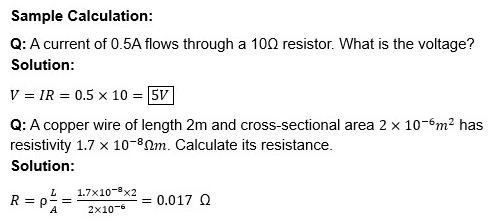
V=IR
Where:
V = Voltage (Volts),
I = Current (Amperes),
R = Resistance (Ohms) - Valid for conductors where current and voltage are directly proportional.
- Factors Affecting Resistance
- Length (L): Resistance increases with length.
- Area (A): Wider wires have less resistance.
- Material: Copper has less resistance than iron.
- Temperature: Higher temperatures increase resistance in metals.
- Formula:
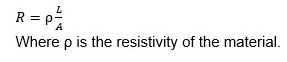
- Where ρ is the resistivity of the material.
Experiment: Verifying Ohm’s Law
Title: Relationship Between Voltage and Current in a Resistor
Materials: Resistor, dry cell, voltmeter, ammeter, switch, wires
Procedure:
- Connect circuit as per standard Ohm’s Law setup.
- Gradually increase voltage and record corresponding current.
- Plot V against I.
Observation: The graph is a straight line, proving Ohm’s Law.
Conclusion: Resistance remains constant; V∝I
Assessment Questions:
- Objective Questions
- Ohm’s Law relates:
A. Voltage, current, resistance
B. Current, power, energy
C. Charge, mass, time
D. Voltage, frequency, period - Which of these will decrease resistance in a wire?
A. Increase length
B. Use thinner wire
C. Use copper instead of iron
D. Heat the wire
- Short Answer Questions
- Define resistance and give its unit.
- Explain why resistance increases with temperature.
- Problem Solving
A wire has a resistance of 5Ω and a current of 2A flows through it.
i. Find the voltage across the wire.
ii. What energy is dissipated in 10 seconds?
Homework:
- Measure the resistance of various materials at home (e.g., pencil lead, foil) using a battery and bulb.
- Draw a labeled diagram showing an Ohm’s Law experiment.
- Use Ohm’s Law to calculate current if 12V is applied across a 4Ω resistor.
Expanded Notes:
- Materials with low resistivity are good conductors (e.g., copper).
- Resistance leads to heat generation in electric cookers and irons.
- Carbon resistors are commonly used in electronics.
- Multimeters help measure resistance directly.
Differentiation:
- Diagrams for visual learners
- Hands-on circuit assembly for kinesthetic learners
- Group calculations for peer learning
Teacher’s Reflection:
- Were learners able to grasp the concept of resistance practically?
- Was the Ohm’s Law graph interpreted correctly?
- Did all groups complete the calculation and experiment?